

The best stone cladding Z panels in the UK for 2026 should be selected by more than colour alone. Stone type, backing construction, panel weight, thickness, wall substrate, installation height and architectural style all affect whether a particular Z panel is suitable for a project.
This 2026 buyer's guide compares eight genuine natural stone Z panels from our current range. Seven use a rigid cement backing with integrated fixing hooks, while Yellow Gneiss uses a lighter mesh-and-adhesive construction. The comparison therefore covers both visual appearance and the physical differences that matter during specification, handling and installation.
Updated for 2026: the sizes, backing types and approximate installed material weights shown below are based on our current product specifications. Natural stone remains inherently variable, so colour, texture and individual stone thickness will vary between panels.
2026 Stone Cladding Z Panel Quick Comparison
| # | Stone Cladding | Backing | Panel Size | Approx. Weight | Best For | Main Consideration |
|---|---|---|---|---|---|---|
| 1 | Oyster Golden Quartz | Cement | 550 × 200 mm | ≈75 kg/m² | Traditional, hospitality & mixed architecture | Hard quartz requires suitable cutting equipment |
| 2 | Black Slate | Cement | 550 × 200 mm | ≈75 kg/m² | Contemporary architecture | Dark surfaces can show dust and dried water marks |
| 3 | Autumn Gold | Cement | 550 × 200 mm | ≈75 kg/m² | Country, hospitality & commercial façades | Strong natural colour variation |
| 4 | Multicolour Slate | Cement | 550 × 200 mm | ≈75 kg/m² | Rustic & landscaped walls | Not suitable where close shade uniformity is required |
| 5 | Blue Diamond | Cement | 550 × 200 mm | ≈75 kg/m² | Cool contemporary schemes | Less suited to strongly warm colour palettes |
| 6 | Grey Granite | Cement | 550 × 200 mm | ≈75 kg/m² | Commercial & public-space architecture | Dense granite requires appropriate diamond cutting equipment |
| 7 | Yellow Gneiss | Mesh & Adhesive | 550 × 200 mm | ≈59 kg/m² | Garden & low-rise exterior walls | Less rigid than cement-backed construction |
| 8 | Grey Vein Granite | Cement | 550 × 200 mm | ≈75 kg/m² | Premium contemporary architecture | Natural veining means pattern cannot be uniform |
1. Oyster Golden Quartz Stone Cladding – Best Overall for 2026
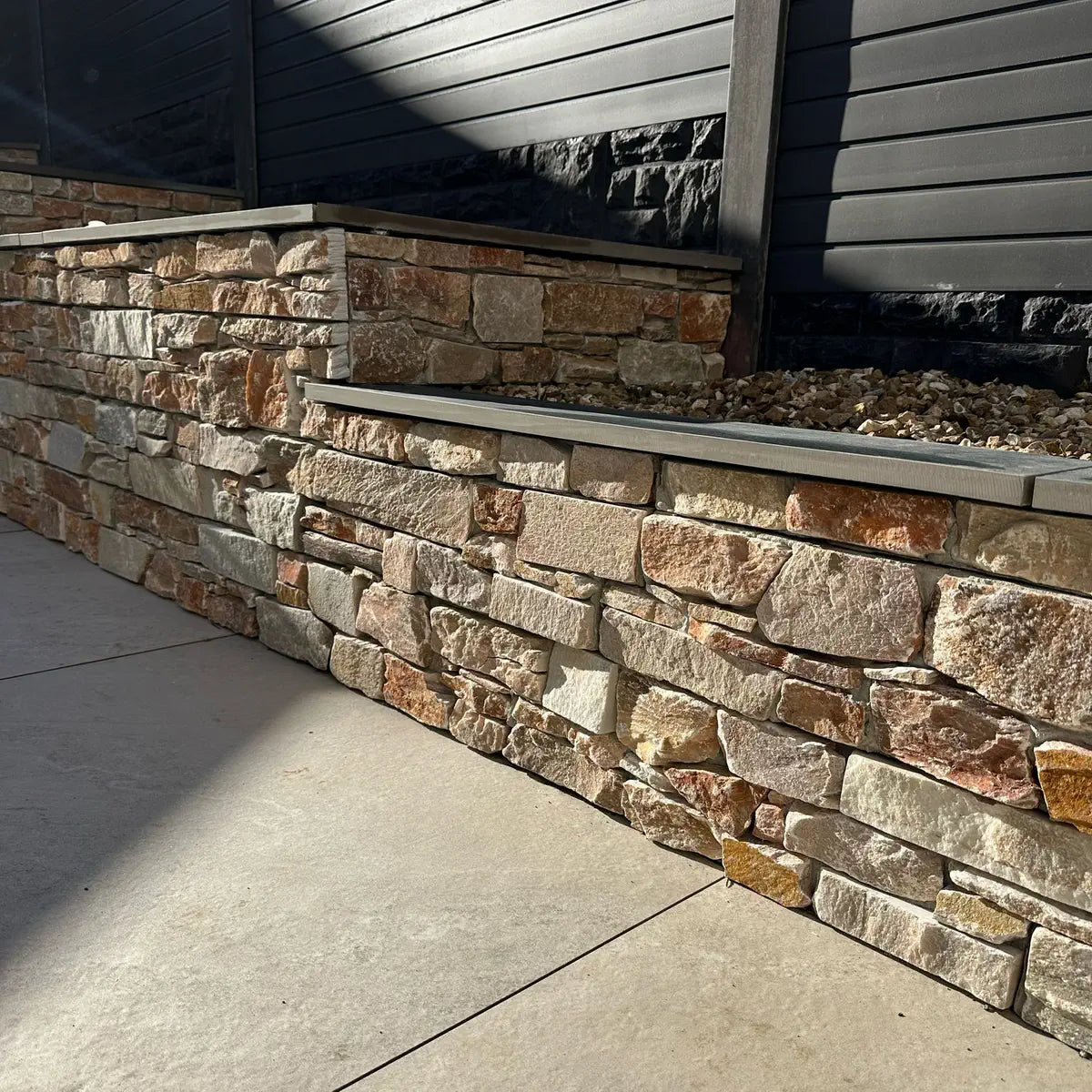
Best for: Country Homes, Cafés, Restaurants and Warm Contemporary Architecture
- Material: Natural quartz stone
- Backing: Cement backing with fixing hooks
- Panel Size: 550 × 200 mm
- Nominal Thickness: 30–50 mm 3D
- Approx. Weight: 75 kg/m²
- Colour: Oyster, gold, buff, cream and warm brown
- Best For: Exterior façades, hospitality buildings, entrances and feature walls
Our Oyster Golden Quartz Stone Cladding ranks first because its warm but relatively balanced colour range can work with a particularly wide variety of architectural materials.
Oyster, cream, buff and golden tones combine naturally with timber, red or buff brick, cream render, charcoal aluminium and large glazed sections. The result can move comfortably between country-house architecture and modern commercial hospitality design.
Advantages: versatile colour palette, substantial cement-backed construction, strong three-dimensional texture and compatibility with both modern and traditional schemes.
Consider before choosing: quartz is a hard natural stone, so site cuts require appropriate diamond cutting equipment. Natural oyster and gold colour variation should also be assessed from samples rather than judged from one photograph alone.
Why choose it: the strongest all-round option where flexibility of architectural style is the main priority.
2. Black Slate Stone Cladding – Best for Modern Architecture
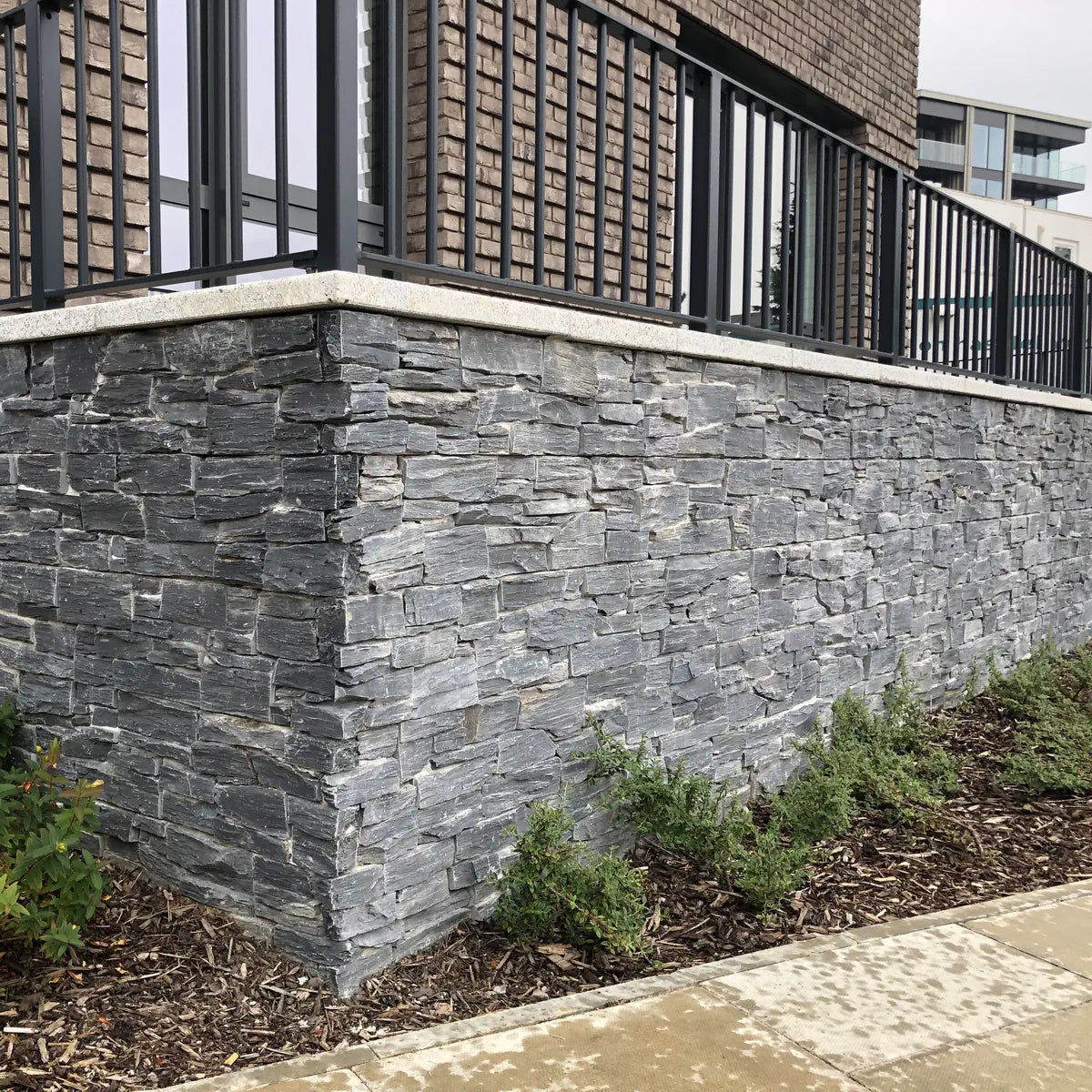
Best for: Contemporary Houses, Commercial Entrances and Dark Feature Walls
- Material: Natural slate
- Backing: Cement backing with fixing hooks
- Panel Size: 550 × 200 mm
- Nominal Thickness: 30–50 mm 3D
- Approx. Weight: 75 kg/m²
- Colour: Black, charcoal and dark grey
- Best For: Contemporary façades, entrances, commercial walls and feature walls
For darker contemporary projects, Black Slate Stone Cladding provides strong charcoal and black tones with the layered texture of genuine natural slate.
The dark surface contrasts particularly well with white render, light paving, glass and anthracite aluminium. Its split face prevents the finished wall from appearing visually flat even where the overall colour scheme is deliberately restrained.
Advantages: strong modern contrast, distinctive layered slate texture and particularly effective results with architectural lighting.
Consider before choosing: dark stone can show dust, dried water marks and some surface contamination more visibly than highly varied lighter stone. Cleaning products and any proposed sealer should be tested before widespread use.
Why choose it: one of the strongest options for minimalist architecture, dark façades and contemporary commercial design.
3. Autumn Gold Stone Cladding – Best for Warm Rural and Commercial Design
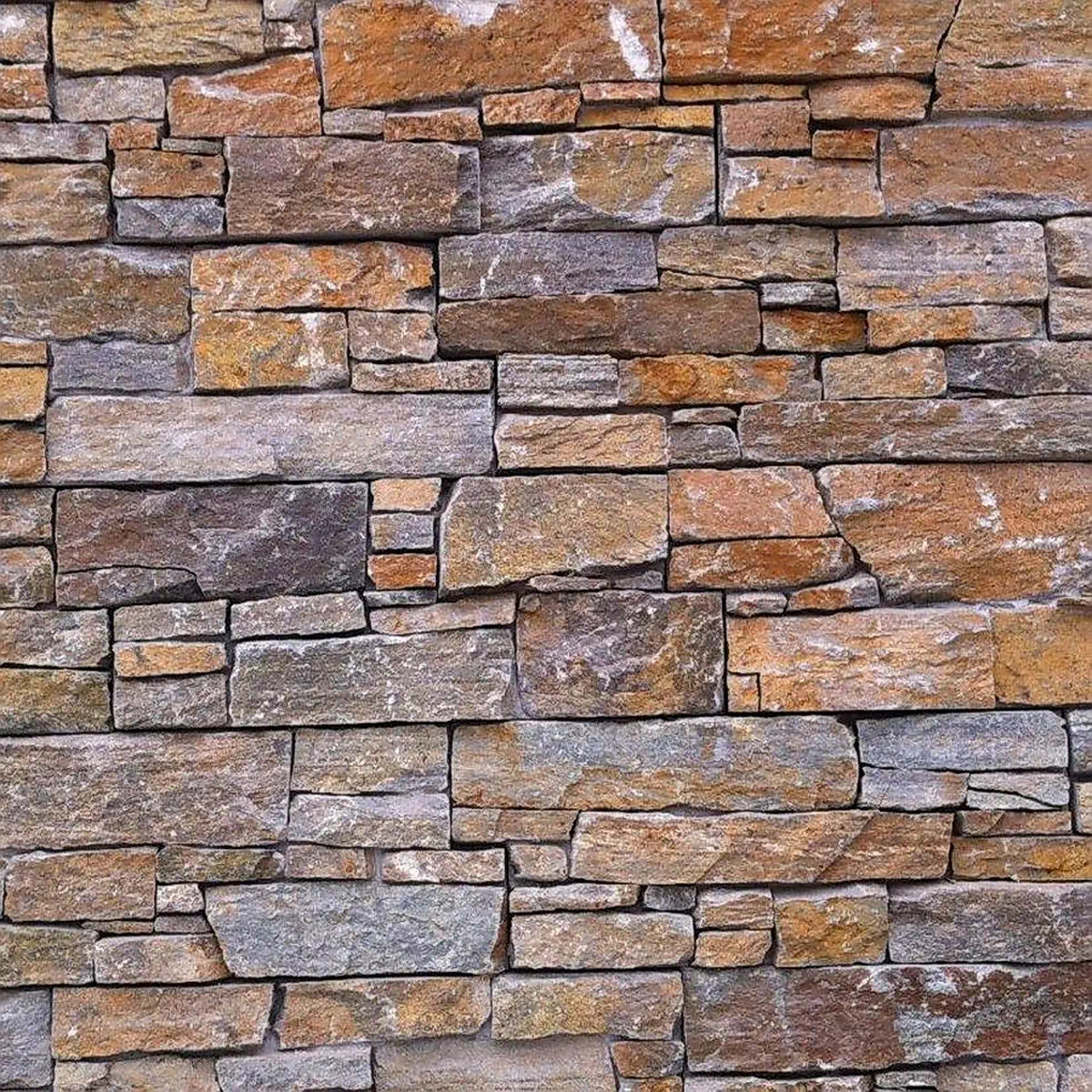
Best for: Country Properties, Pubs, Restaurants and Commercial Hospitality
- Material: Natural stone
- Backing: Cement backing with fixing hooks
- Panel Size: 550 × 200 mm
- Nominal Thickness: 30–50 mm 3D
- Approx. Weight: 75 kg/m²
- Colour: Gold, brown, rust, buff and earthy variation
- Best For: Rural properties, cafés, pubs, restaurants and exterior feature walls
For projects requiring warmer and more pronounced natural colour, Autumn Gold Stone Cladding combines gold, brown, rust and buff tones with a rigid cement-backed structure.
Its natural variation works particularly well where designers want the finished wall to feel established and connected with rural surroundings. At the same time, the stone can be paired with glazing, dark metalwork and timber-effect panels to produce a contemporary hospitality façade.
Advantages: rich natural variation, strong countryside character and a rigid backing that can form part of an appropriately designed mechanically restrained installation.
Consider before choosing: colour variation is one of Autumn Gold's defining characteristics. It is therefore not the best option where architects or homeowners require a tightly controlled and uniform wall colour.
Why choose it: particularly strong for pubs, restaurants, country properties and commercial developments requiring warm architectural character.
4. Multicolour Slate Stone Cladding – Best for Natural Colour Variation
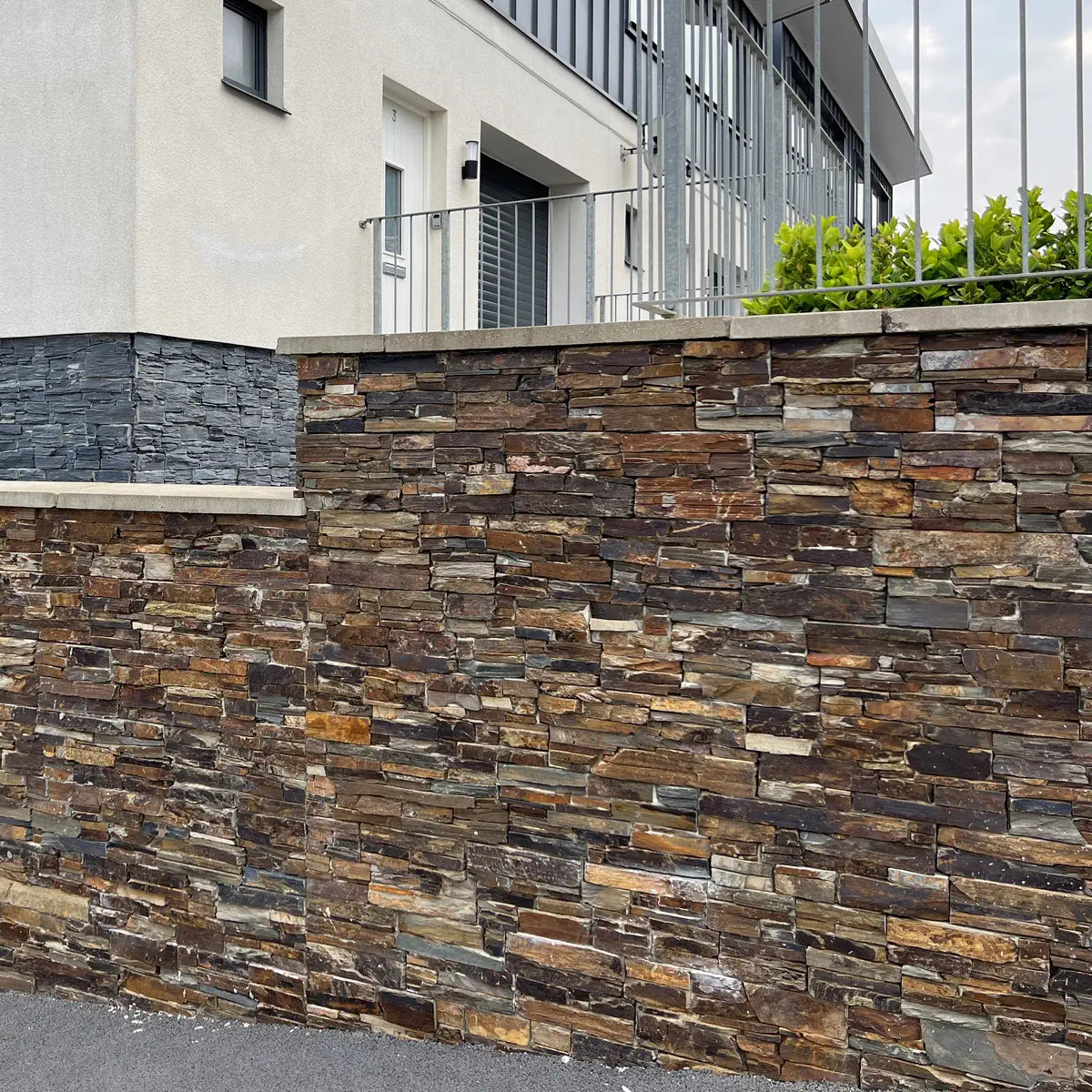
Best for: Rustic Walls, Garden Architecture and Highly Varied Natural Finishes
- Material: Natural slate
- Backing: Cement backing with fixing hooks
- Panel Size: 550 × 200 mm
- Nominal Thickness: 30–50 mm 3D
- Approx. Weight: 75 kg/m²
- Colour: Rust, brown, grey, charcoal and mixed mineral tones
- Best For: Garden walls, boundary walls, rustic façades and landscape architecture
If visible natural variation is the objective, Multicolour Slate Stone Cladding provides the strongest mixture of contrasting natural tones within this eight-product comparison.
Individual pieces can differ significantly, creating an intentionally varied wall rather than a manufactured-looking uniform surface. This works especially well beside planting, timber, traditional paving and landscaped outdoor environments.
Advantages: pronounced natural mineral colour, strong rustic character and a surface where individual stones remain visibly different.
Consider before choosing: this is not a suitable choice where close colour matching or a tightly controlled architectural shade is required. Buyers should actively want visible natural variation.
Why choose it: the best option where genuine variation and rustic natural character are more important than colour consistency.
5. Blue Diamond Stone Cladding – Best for Contemporary Blue-Grey Design
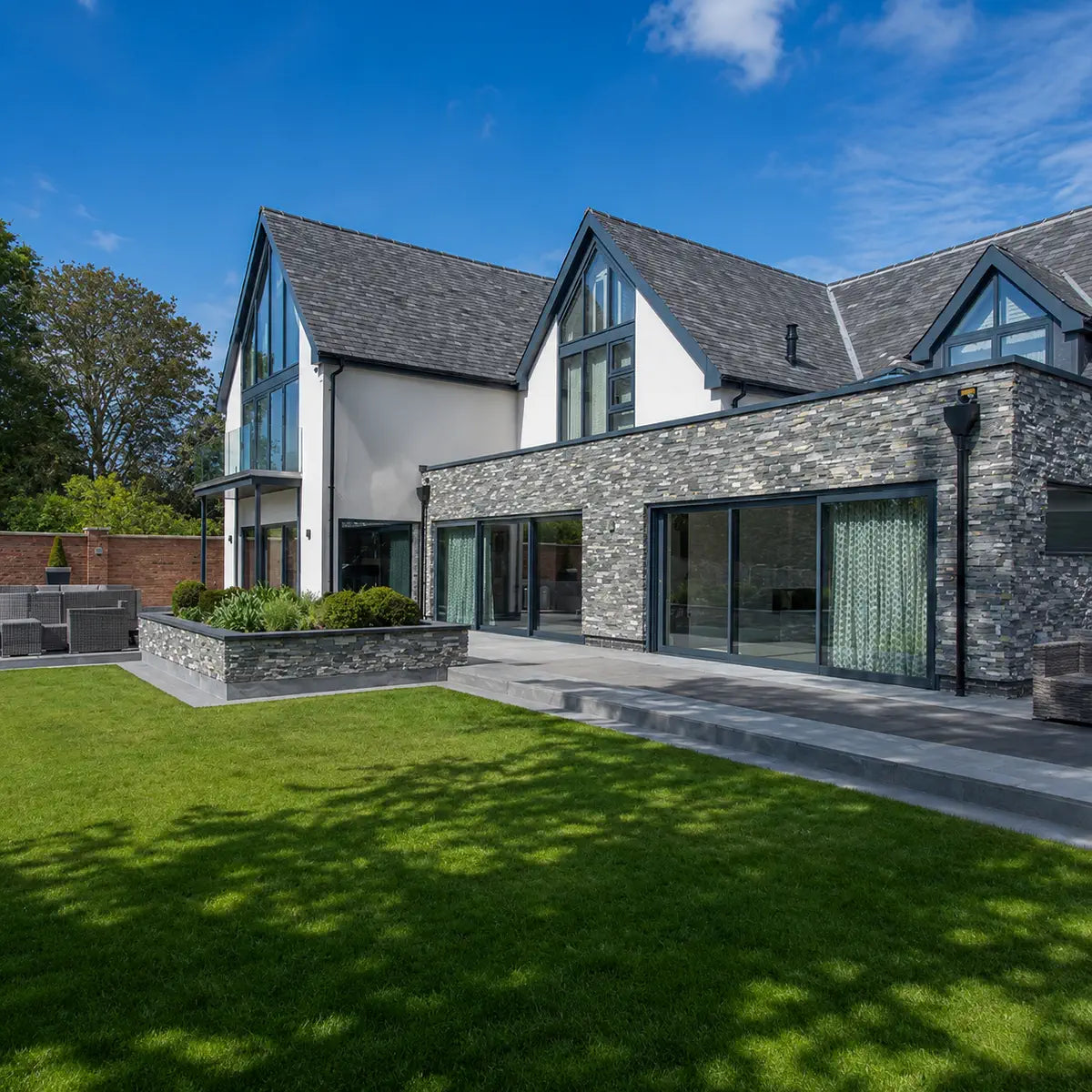
Best for: Modern Houses, Entrances and Cool-Toned Architectural Schemes
- Material: Natural stone
- Backing: Cement backing with fixing hooks
- Panel Size: 550 × 200 mm
- Nominal Thickness: 30–50 mm 3D
- Approx. Weight: 75 kg/m²
- Colour: Blue-grey, steel grey and darker natural variation
- Best For: Contemporary façades, modern entrances and commercial architecture
For cooler architectural colour schemes, Blue Diamond Stone Cladding offers a blue-grey natural stone alternative to conventional warm gold and brown cladding.
It coordinates particularly well with anthracite aluminium, glass, grey porcelain, granite paving and smooth contemporary render. Natural tonal variation prevents the wall from looking like a uniform manufactured grey product.
Advantages: distinctive cool colour palette, strong compatibility with modern materials and a more individual appearance than conventional neutral grey cladding.
Consider before choosing: its cooler blue-grey palette may be less sympathetic to strongly warm red brick, terracotta or highly traditional architectural colour schemes.
Why choose it: one of the best options for modern buildings where natural texture is required without introducing warm rustic tones.
6. Grey Granite Stone Cladding – Best for Commercial and Public-Space Architecture
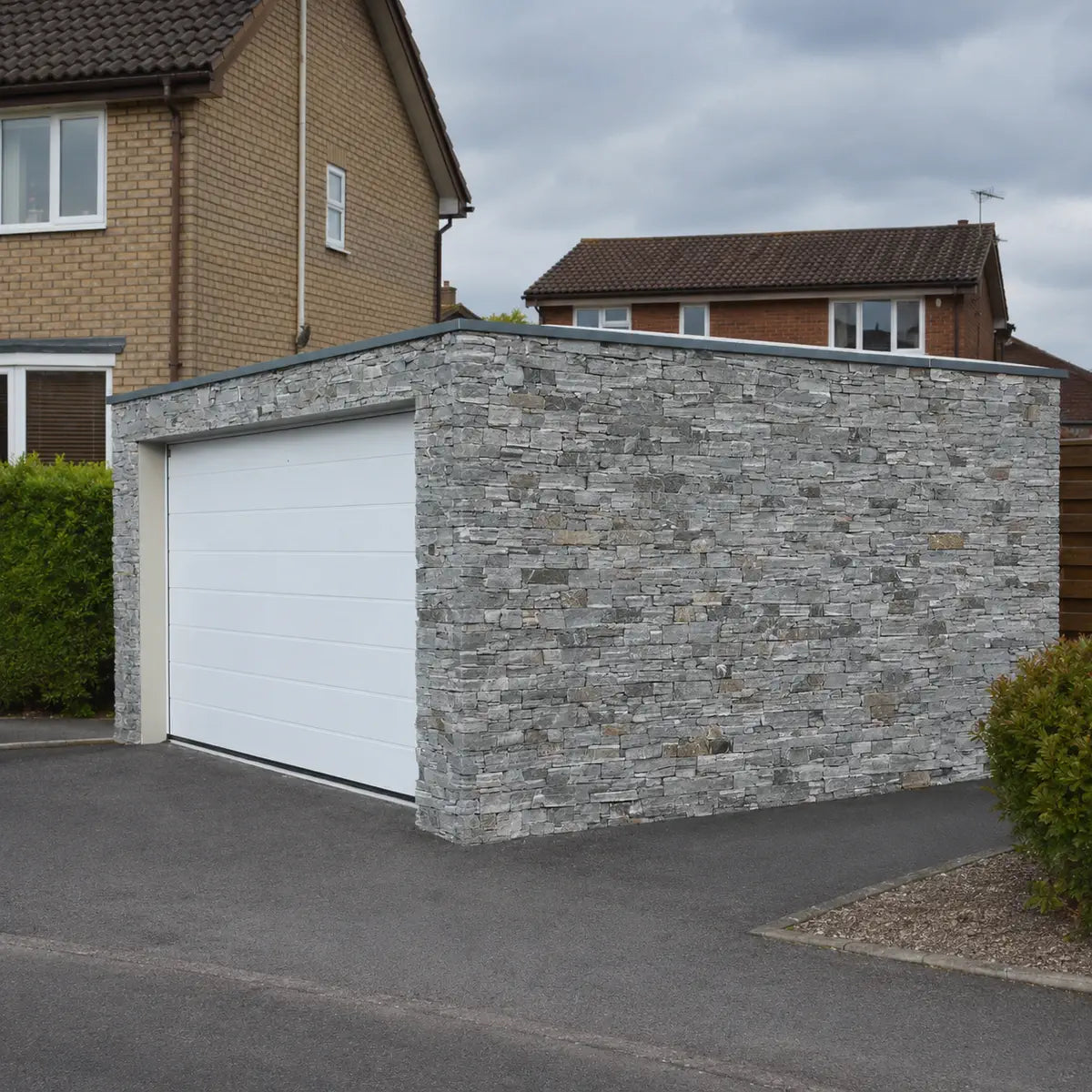
Best for: Commercial Buildings, Public Realm and Modern Landscaping
- Material: Natural granite
- Backing: Cement backing with fixing hooks
- Panel Size: 550 × 200 mm
- Nominal Thickness: 30–50 mm 3D
- Approx. Weight: 75 kg/m²
- Colour: Mid grey, silver grey and darker mineral variation
- Best For: Commercial façades, public spaces, boundary walls and contemporary landscaping
For commercial, public-facing and landscape projects, Grey Granite Stone Cladding provides one of the most neutral architectural palettes in the range.
Grey granite coordinates naturally with concrete, aluminium, stainless steel, glass, grey paving and contemporary landscaping. The split natural surface introduces texture without forcing a strong competing colour into the design.
Advantages: neutral architectural appearance, strong material durability and easy coordination with contemporary commercial materials.
Consider before choosing: granite is dense and hard. Accurate site cutting requires suitable diamond cutting equipment, and the heavy cement-backed panels require an appropriately strong substrate.
Why choose it: particularly effective where architects need natural texture within a restrained commercial or public-realm colour palette.
7. Yellow Gneiss Stone Cladding – Best Lightweight Warm-Toned Z Panel
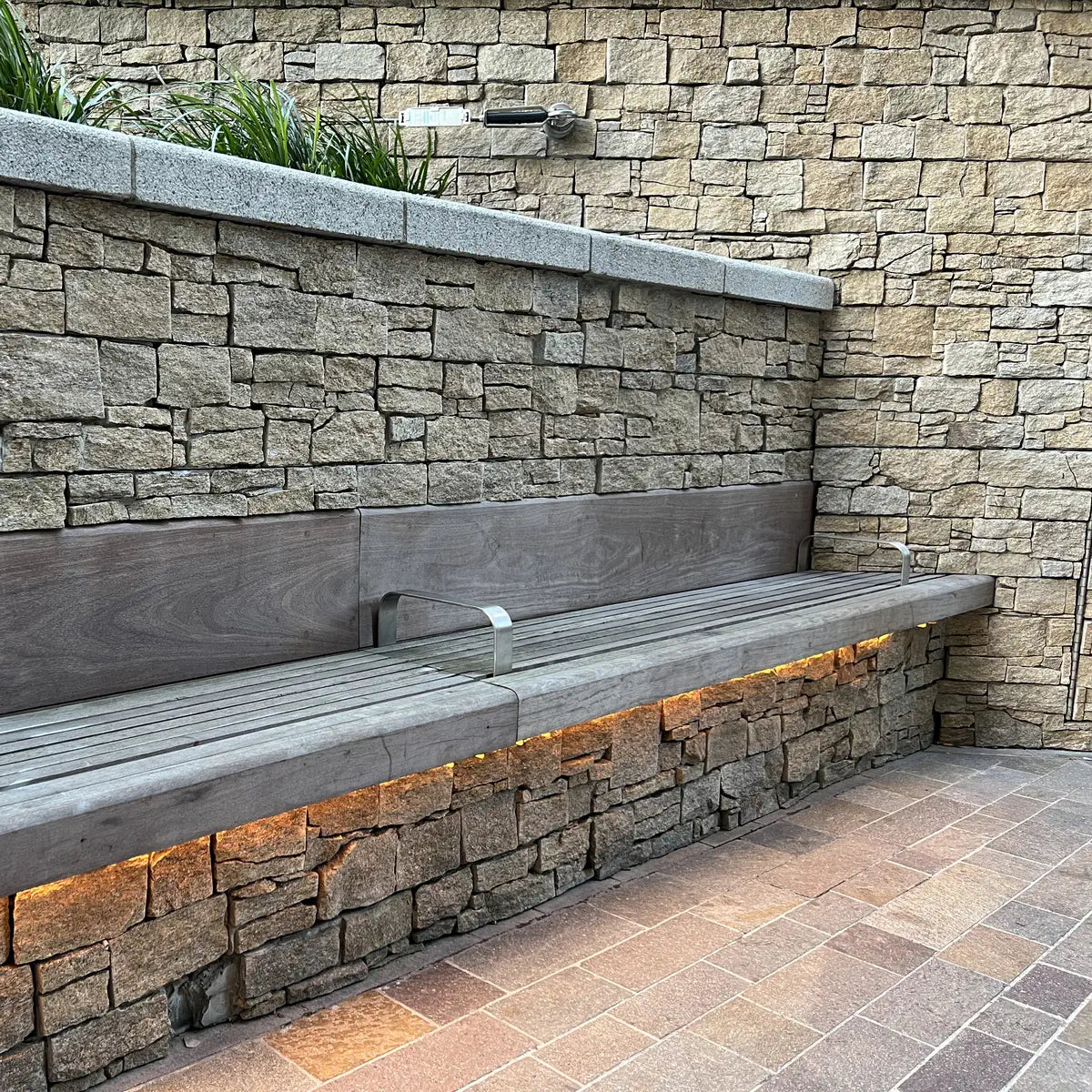
Best for: Garden Walls, Exterior House Walls and Warm Landscaped Architecture
- Material: Natural stone
- Backing: Mesh and adhesive
- Panel Size: 550 × 200 mm
- Nominal Panel Specification: 20–40 mm
- Approx. Weight: 59 kg/m²
- Colour: Yellow, buff, cream and light earthy tones
- Best For: Garden walls, boundary walls, exterior façades and landscape structures
For projects where a lighter backing construction is preferred, Yellow Gneiss Stone Cladding is the only mesh-backed product in this Top 8 comparison.
At approximately 59 kg/m² based on the current packed product specification, it is materially lighter than the approximately 75 kg/m² cement-backed products. This difference can make lifting, positioning and handling easier on suitable low-rise installations.
Its yellow, buff and cream tones also make it particularly effective with gardens, planting, cream render, buff brick, timber, grey paving and natural landscape materials.
Advantages: lighter weight, easier handling, warm natural colour and greater adaptability than rigid cement-backed panels where individual stone pieces need to accommodate irregular or curved surfaces.
Consider before choosing: mesh backing does not provide the same rigid support structure as cement backing. Where mechanical restraint is an important part of a higher-level or heavy-duty wall specification, a cement-backed product may be more appropriate.
Why choose it: the strongest lightweight option in this comparison for garden, residential and other appropriately specified low-rise wall projects.
8. Grey Vein Granite Stone Cladding – Best for Premium Architectural Texture
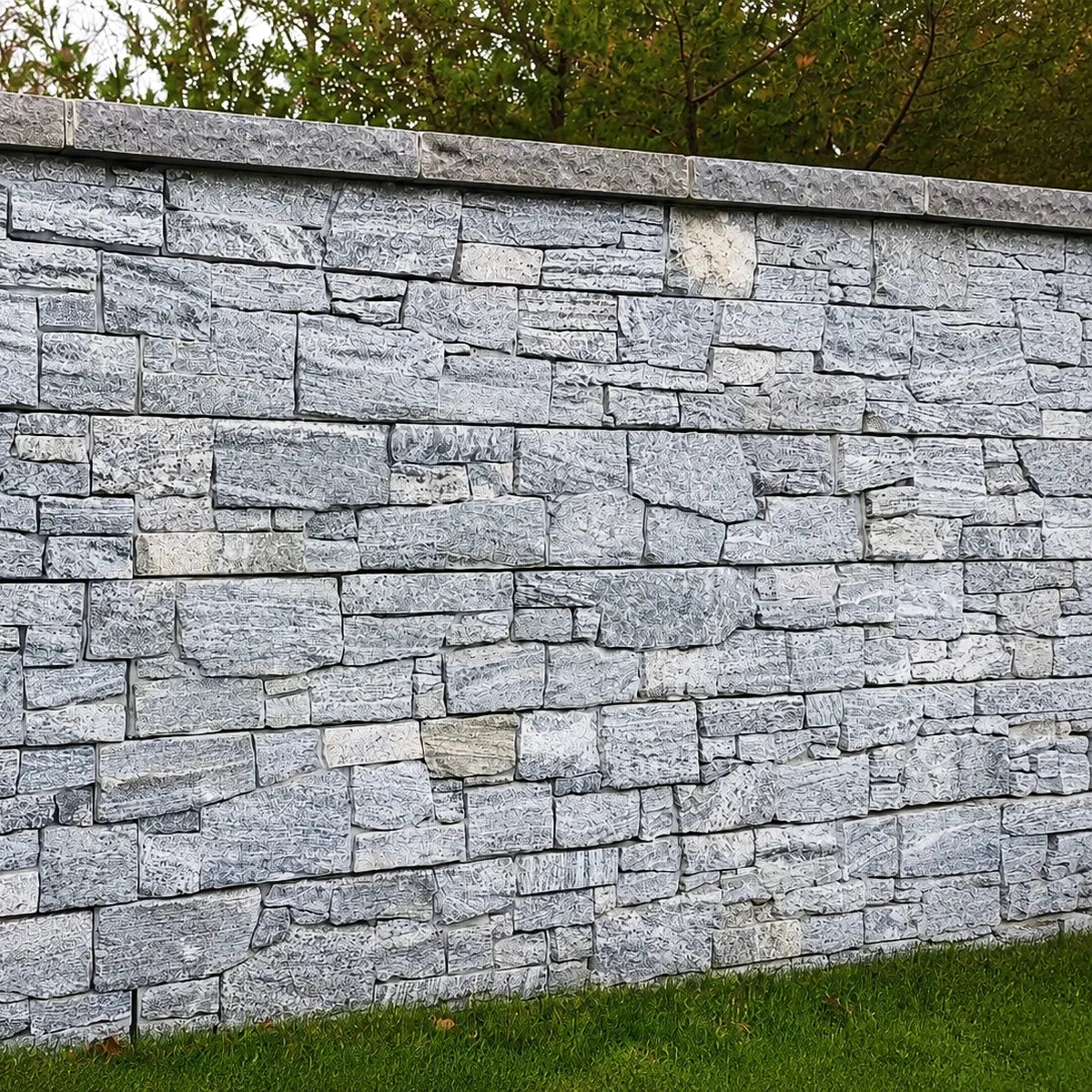
Best for: High-End Contemporary Homes and Architectural Feature Walls
- Material: Natural granite
- Backing: Cement backing with fixing hooks
- Panel Size: 550 × 200 mm
- Nominal Thickness: 30–50 mm 3D
- Approx. Weight: 75 kg/m²
- Colour: Grey with contrasting natural veins and mineral variation
- Best For: Premium façades, entrances, modern houses and commercial feature walls
Where a neutral grey colour is required but a more distinctive natural pattern is preferred, Grey Vein Granite Stone Cladding combines contemporary grey tones with visible natural veins and mineral markings.
The grey base remains compatible with modern glass, metalwork and paving, while the natural veining gives the wall greater individuality than a more consistent grey granite finish.
Advantages: premium natural appearance, visible mineral character and strong compatibility with high-end contemporary architecture.
Consider before choosing: the natural veins and markings vary from piece to piece. It should not be selected where the objective is a completely uniform grey wall pattern.
Why choose it: particularly suitable where a contemporary grey façade needs stronger natural stone character and visible mineral variation.
Which Stone Cladding Z Panel Is Best?
There is no single Z panel that is technically or aesthetically best for every project. The most appropriate choice depends on backing construction, wall strength, installation height, colour scheme, surrounding materials and the degree of natural variation required.
- Best overall: Oyster Golden Quartz
- Best for modern architecture: Black Slate
- Best for countryside and hospitality: Autumn Gold
- Best for natural colour variation: Multicolour Slate
- Best cool contemporary colour: Blue Diamond
- Best for commercial and public spaces: Grey Granite
- Best lightweight warm-toned option: Yellow Gneiss
- Best for premium architectural texture: Grey Vein Granite
Cement-Backed vs Mesh-Backed Z Panels
Cement-Backed Z Panels
The seven cement-backed products in this guide use a rigid cementitious backing and currently weigh approximately 75 kg/m² based on a 33 kg box covering 0.44 m².
The main advantages are rigidity, a flat supporting back and the ability to incorporate mechanical restraint into an appropriately designed fixing system. This can be useful for substantial exterior walls, commercial projects and locations where additional restraint is required.
The disadvantages are equally important: the panels are heavier to lift, place, transport and support. They are also unsuitable for curved wall applications without substantial alteration.
Mesh-Backed Z Panels
Yellow Gneiss uses a mesh-and-adhesive backing and currently weighs approximately 59 kg/m² based on a 26 kg box covering 0.44 m².
The lower weight makes the panel easier to handle, while the mesh construction gives greater adaptability. However, it does not provide the same rigid backing structure as a cement-backed panel.
Backing type should therefore be selected according to the actual wall construction and fixing strategy rather than assuming that either system is universally superior.
Ordering and Wastage Guidance for 2026 Projects
Natural stone Z panels require allowance for cutting, corner detailing, colour blending and occasional damage. Our current ordering guidance is to allow at least 10% additional material for normal cuts and wastage, with more considered where a project contains multiple corners, openings, short returns or complicated wall shapes.
Ordering sufficient material at the beginning of the project is also preferable to relying on a later top-up order because natural stone colour and mineral variation can differ between production batches.
8 Stone Cladding Colour FAQs
1. Is Oyster Golden Quartz the best stone cladding colour for traditional houses?
Oyster Golden Quartz is one of the most adaptable options for traditional British properties because its cream, buff, gold and brown tones coordinate naturally with brick, timber, traditional paving and landscaping. It can also work successfully with modern glazing and dark aluminium.
2. Is Black Slate stone cladding suitable for modern houses?
Yes. Black Slate is particularly effective in contemporary architecture because its charcoal and dark grey colour provides strong contrast with white render, glass, pale paving and modern aluminium windows.
3. Where does Autumn Gold stone cladding work best?
Autumn Gold works particularly well on country properties, pubs, cafés, restaurants, garden walls and hospitality buildings where warm gold, brown and rust variation contributes to a more rural or established appearance.
4. Does Multicolour Slate stone cladding have a lot of colour variation?
Yes. Multicolour Slate is deliberately highly varied. Rust, brown, grey and darker mineral colours can differ considerably between individual pieces, so it is better suited to projects that actively want natural variation.
5. What colours work well with Blue Diamond stone cladding?
Blue Diamond works particularly well with charcoal, black, white and cool grey finishes, including anthracite aluminium, glass, grey porcelain paving, granite and contemporary render.
6. Is Grey Granite suitable for commercial and public-space projects?
Yes. Its restrained grey colour works easily with concrete, aluminium, glass, steel, modern paving and landscaping, making it particularly useful for commercial entrances, boundary structures and public-facing architecture.
7. What is Yellow Gneiss stone cladding best used for?
Yellow Gneiss is particularly suitable for garden walls, exterior house walls, boundary walls and landscaped structures where warm natural colour and a lighter mesh-backed construction are preferred.
8. What is the difference between Grey Granite and Grey Vein Granite?
Both use a predominantly grey palette, but Grey Vein Granite contains more noticeable natural veins and mineral markings. Grey Granite provides a more restrained architectural appearance, while Grey Vein Granite creates a stronger decorative natural pattern.
Trade, Project Pricing & Sample Enquiries
Planning a larger residential, landscaping, hospitality or commercial stone cladding project? Contractors, landscapers, architects, designers and developers can contact us before ordering to discuss material samples, project quantities and volume pricing.
Large commercial and trade requirements can qualify for project-specific pricing, while ordering samples before final specification can help assess natural colour, surface texture and compatibility with surrounding materials.
Apply for a Trade Account | Commercial Supply & Sample Enquiries
Looking for heavy Stone Cladding Z Panels or lightweight Split Face Tiles for your home or building? Whether you are covering an exterior wall, building façade, entrance, garden wall or interior feature wall, browse our wider Stone Cladding Z Panels & Split Face Tiles collection to compare a broader range of natural stone colours, textures and panel styles for different projects. With more options available across the collection, there is a strong chance you will find a real stone cladding panel or tile that suits both the appearance of your property and the practical requirements of your project.


